Prepositions of time can be tricky to use, even for native speakers. In French, there are different prepositions to use depending on the context. This blog post will explain when and how to use prepositions of time in French sentences.
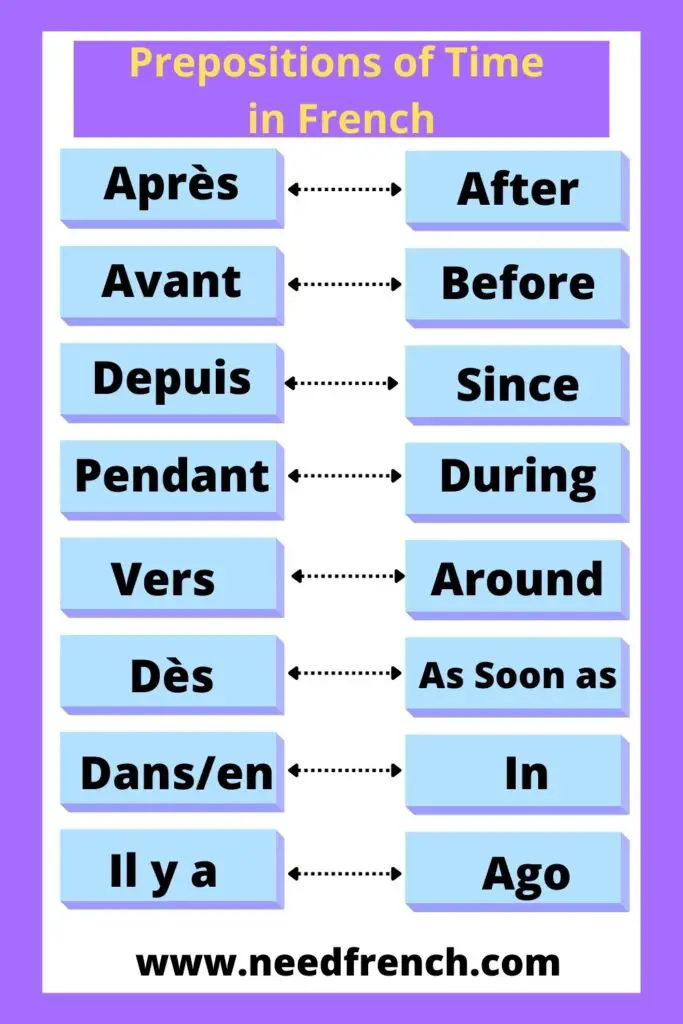
Table of Contents
ToggleHow to Use Prepositions of Time in French.
When to Use Prepositions of Time
Prepositions of time are used to indicate when something happened, is happening, or will happen. In French, there are 10 main prepositions of time: à, dans, en, après, avant, vers, depuis, pendant, dès and entre. Each preposition has a different meaning and usage.
Here are some general rules for using prepositions of time in French:
-Use à with time expressions that can be counted (e.g., minutes, hours, days, months, years).
-Use dans when referring to a period of time that has not yet begun or when referring to a future event.
-Use après when referring to an event that has already happened.
-Use avant when referring to an event that will happen before another event.
–En can be used with both past and future events. However, it is most commonly used with future events.
–Entre is only used when referring to two events that are happening at the same time.
–Pendant is used with past and future actions, to describe how long something lasted for or will last for.
–Vers can also mean “around a certain time“
–Depuis means “since” or “for.” It is used to indicate the duration of an event.
–dès que is a conjunction that means “as soon as.” Dès que does not take the subjunctive.
How to Use Prepositions of Time in French Sentences
Now let’s take a look at how to use these prepositions in French sentences. Remember that the placement of the preposition can vary depending on whether the verb is conjugated in the indicative or subjunctive mood and whether you’re using negative or interrogative word order.
Here are some examples of how to use prepositions of time in French sentences:
Indicative mood: Je vais au cinéma ce soir (I’m going to the movies tonight). Il arrive dans une heure (He’ll arrive in an hour). J’ai fini avant midi (I finished before noon).
Subjunctive mood: Que tu viennes ce soir! (Come tonight!) Qu’il arrive demain! (Let him arrive tomorrow!) Qu’elle parte avant moi! (Let her leave before me!)
Negative word order: Je ne vais pas au cinéma ce soir (I’m not going to the movies tonight). Il ne viendra pas demain (He won’t come tomorrow). Nous n’arriverons pas à temps pour le déjeuner (We won’t arrive in time for lunch).
Interrogative word order: Vas-tu au cinéma ce soir? (Are you going to the movies tonight?) Arrivera-t-il demain? (Will he arrive tomorrow?) Partira-t-elle avant moi?(Will she leave before me?)